Complete Drainage Solutions for Foundation Protection

Downspout Services

Complete drainage solutions — extensions, rerouting, and underground tie-ins for Westchester properties.

Call anytime

Downspouts are the critical last link in any gutter drainage system, responsible for moving collected rainwater safely away from foundations, walkways, and landscaping. With Yonkers receiving over 50 inches of annual rainfall — 67% above the national average — properly functioning downspouts stand between a dry basement and costly water damage. Yonkers Gutter Genius provides expert downspout installation, repair, replacement, and extensions across Westchester County.

Why Downspouts Matter for Yonkers Properties

Every inch of rain that falls on a roof gets funneled through the gutter system and directed toward the downspouts. On a typical 1,500-square-foot Yonkers roof, a single inch of rain produces roughly 935 gallons of water. Multiply that by 50 inches of annual rainfall, and the numbers become staggering — nearly 47,000 gallons per year rushing through the downspout system of an average home. Without properly sized, strategically placed, and well-maintained downspouts, that water has nowhere to go but straight into the foundation.

Yonkers' clay-heavy soil compounds the drainage challenge significantly. Unlike sandy or loamy soils that absorb water quickly, Westchester County's clay substrate retains moisture, creating prolonged saturation zones around foundations. The City of Yonkers Stormwater Management Program addresses municipal-level runoff, but individual property drainage remains each homeowner's responsibility. When downspouts discharge too close to the building or fail entirely, hydrostatic pressure builds against basement walls, forcing water through cracks and mortar joints that may have held for decades.
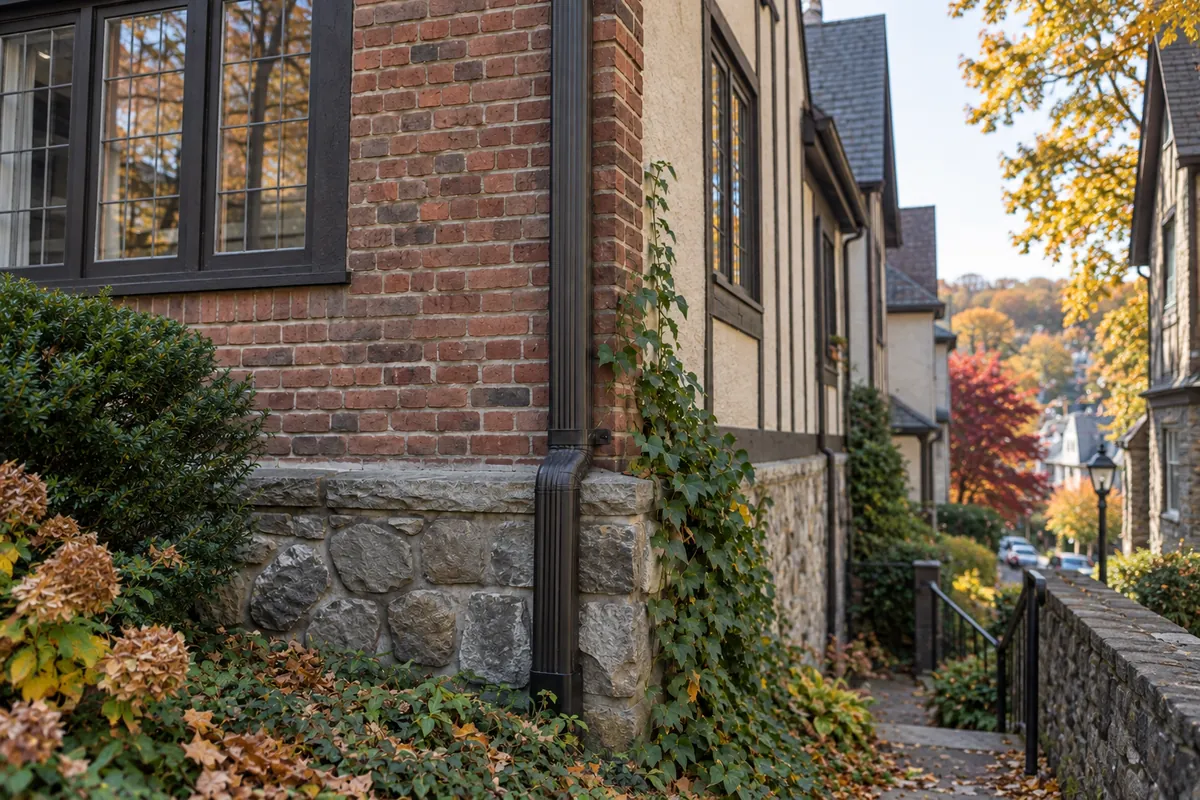
Black aluminum downspout installed on a Yonkers residential property

Neighborhood-Specific Challenges

Park Hill properties face particularly steep hillside drainage challenges where gravity accelerates water flow toward downhill foundations. Undersized or poorly angled downspouts on Park Hill homes often send concentrated water streams cascading along foundation walls rather than directing flow safely downhill. Getty Square's dense lot configurations present a different problem — limited runoff space between buildings means every downspout placement decision matters, and shared drainage between attached multi-family structures requires careful coordination. In Crestwood, mature oak, maple, and sycamore trees contribute heavy leaf and seed debris that clogs downspouts from the inside, sometimes creating ice dams at downspout elbows during winter freeze cycles.
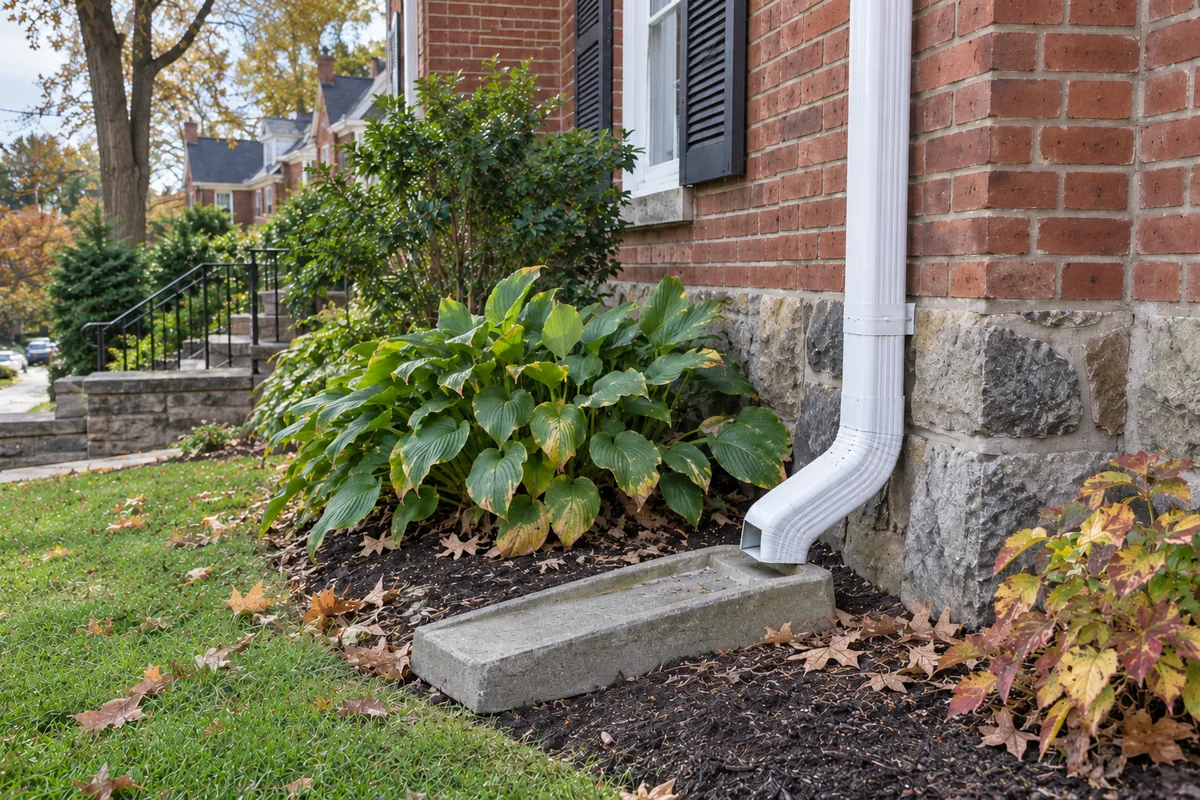
White downspout directing water away from a home foundation

Roughly 35% of Yonkers homes were built before 1950, and many retain original or undersized 2x3-inch downspout systems designed for an era before modern drainage standards. These aging systems frequently feature corroded joints, loose mounting brackets, and insufficient capacity for the rainfall volumes that Westchester County experiences during nor'easters and summer thunderstorms.
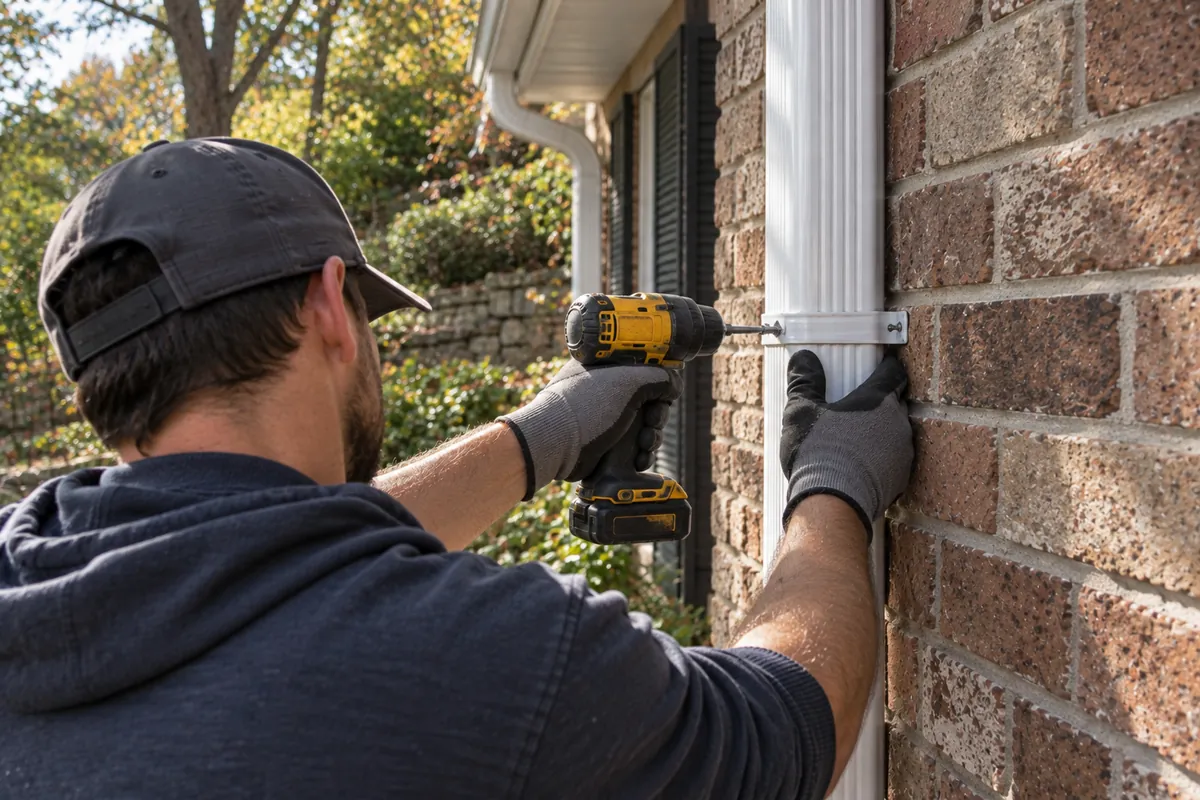
Professional downspout installation on a Westchester County home

The 4-6 Foot Rule

Every downspout should discharge water a minimum of 4 to 6 feet away from the foundation. Shorter distances allow water to pool in the backfill zone — the loosely compacted soil around the foundation that absorbs water faster than undisturbed ground. Extensions, splash blocks, or underground drainage connections all serve this critical minimum distance requirement.

Downspout Services Available

Yonkers Gutter Genius handles every aspect of downspout work: new installation for additions and re-roofing projects, replacement of deteriorated or undersized systems, repair of loose brackets and leaking joints, extensions and splash blocks for proper discharge distance, and underground drainage connections to French drains or dry wells.

Downspout Services Breakdown

From simple repairs to complete underground drainage systems, each service addresses a specific stage of downspout performance and longevity.

New Downspout Installation

$75 - $200 per unit

New installations involve sizing the correct downspout profile — 2x3-inch for smaller roof sections or 3x4-inch for primary drainage runs — and optimizing placement for maximum water capture. Proper positioning avoids high-traffic walkways and directs discharge toward grade-appropriate areas. Each installation includes elbows, brackets, and a discharge component at the base.

🔄

Downspout Replacement

$100 - $250 per unit

Replacement projects often involve upgrading from undersized 2x3-inch systems to 3x4-inch profiles that handle higher volumes. Material matching ensures visual consistency with existing gutters — aluminum, copper, or galvanized steel. Replacement also provides an opportunity to correct poor original placement that may have directed water too close to the foundation.

🔧

Downspout Repair

$50 - $150

Common repairs include refastening loose mounting brackets that allow sections to separate during wind events, sealing leaking joints at elbow connections where corrosion develops over time, and clearing clogs caused by leaf debris, shingle granules, or animal nests. Timely repairs prevent small issues from escalating into full replacement needs.

➡️

Extensions and Splash Blocks

$25 - $75 per unit

Extensions add length to the downspout discharge point, pushing water further from the foundation. Options include rigid aluminum extensions, flexible corrugated pipe, and flip-up hinged extensions that fold out of the way during mowing. Splash blocks provide an economical base-level solution that prevents soil erosion directly beneath the discharge point.

🌊

Underground Drainage

$15 - $30 per LF

Underground drainage connects downspouts to buried pipe that carries water to a French drain, dry well, or daylight outlet far from the building. This approach eliminates surface water entirely and works especially well for Getty Square's tight lot configurations. Yonkers' clay soil requires proper gravel bedding and strategic dry well placement to ensure effective absorption at the discharge point.

All pricing reflects typical Westchester County ranges. Final costs depend on material selection, building height, site accessibility, and project complexity.

Have questions? Call anytime.

No obligation — free estimates available Monday through Saturday.

(914) 786-6569 Call For Free Estimate

How Many Downspouts Does a Home Need?

The standard rule of thumb calls for one downspout for every 20 to 30 linear feet of gutter. A typical Yonkers single-family home with 150 to 200 linear feet of gutter requires between 5 and 10 downspouts, depending on roof pitch, gutter size, and local rainfall intensity. Properties on the lower end of that range frequently experience overflow during heavy storms — a telltale sign that additional downspouts could resolve the problem without replacing the entire gutter system.

Roof pitch plays a significant role in downspout capacity planning. Steeper roofs accelerate water delivery to the gutter trough, creating peak flow rates that overwhelm undersized or widely spaced downspouts. A 12/12 pitch roof delivers water nearly twice as fast as a 4/12 pitch roof, meaning steep-roofed Yonkers homes need downspouts at closer intervals or larger profiles to handle surge volumes.

Given Yonkers' 50 inches of annual rainfall — well above the national average of 30 inches — the 3x4-inch downspout profile is the recommended standard for most residential applications. The larger profile handles approximately twice the water volume of 2x3-inch systems, providing critical headroom during the intense rainfall events that Westchester County experiences during summer thunderstorms and nor'easters.

Downspout Size Drainage Capacity Best For
2x3-inch ~600 sq ft of roof area Small roof sections, dormers, bay windows
3x4-inch ~1,200 sq ft of roof area Primary drainage runs, main roof sections (recommended for Yonkers)
4-inch round ~1,000 sq ft of roof area Historic properties, half-round gutter systems

Signs Downspouts Need Attention

Downspout problems rarely announce themselves dramatically. These six indicators signal that a professional assessment is warranted before minor issues become foundation-level concerns.

1

Overflowing Gutters Despite Being Clean

When gutters overflow but the trough itself is clear of debris, the blockage is almost certainly in the downspout. Leaf matter, shingle granules, and even bird nests accumulate inside downspout elbows, restricting flow. During Yonkers' heaviest rain events, even a partial blockage can cause full-gutter overflow.

2

Water Pooling at Foundation

Standing water within 4 feet of the foundation after rainfall points to inadequate downspout discharge distance. This is especially common on pre-war Yonkers homes where original downspouts were installed without extensions — a practice standard decades ago but now recognized as a foundation risk in clay-heavy Westchester soil.

3

Staining on Exterior Walls

Dark vertical streaks running down exterior siding or masonry below gutter lines indicate leaking downspout joints. The leak allows water to sheet down the wall surface rather than traveling through the enclosed downspout channel. Left uncorrected, this accelerates paint failure, mortar deterioration, and wood rot on fascia boards.

4

Erosion Near Downspout Base

Visible erosion channels, exposed roots, or displaced mulch at the downspout discharge point signal concentrated water impact without adequate dispersion. Park Hill properties are particularly susceptible, where hillside grades amplify erosive force. Splash blocks, extensions, or underground drainage resolve the concentrated discharge problem.

5

Visible Damage or Separation

Dented sections, separated joints, or brackets pulling away from the wall compromise the entire drainage chain. High winds along the Hudson River corridor and heavy snow loads from Yonkers winters stress mounting hardware, gradually loosening connections that appeared secure during installation. Annual bracket inspections catch these failures early.

6

Ice Buildup at Downspout Base

Ice formations at the base of downspouts during winter indicate drainage that pools rather than flows away. This ice expands and contracts through Yonkers' November-through-March freeze-thaw cycles, eventually cracking the lower downspout section and damaging the foundation discharge area. Proper grading and extensions prevent the pooling that creates ice buildup.

Have questions? Call anytime.

No obligation — free estimates available Monday through Saturday.

(914) 786-6569 Call For Free Estimate

Downspout Services FAQ

Most homes need one downspout for every 20 to 30 linear feet of gutter. A typical Yonkers single-family home requires between 5 and 10 downspouts depending on roof size and pitch. Given Yonkers' 50 inches of annual rainfall, erring toward the higher end of that range ensures adequate drainage capacity during heavy storms.

Three common signs indicate a clogged downspout: gutters overflowing despite being clean on top, little or no water flowing from the downspout base during rain, and water staining on exterior walls near downspout joints. Tapping the outside of the downspout can also reveal blockages — a solid sound instead of a hollow ring suggests debris buildup inside.

The 3x4-inch rectangular downspout is the recommended standard for Westchester County homes. This larger profile handles significantly more water volume than the smaller 2x3-inch size and is better suited to the region's 50 inches of annual rainfall. Properties with steep roof pitches or large roof surface areas benefit especially from the increased capacity of 3x4 downspouts.

Downspouts channel collected rainwater from gutters and direct it a minimum of 4 to 6 feet away from the foundation. Without this directed discharge, water pools at the foundation base, creating hydrostatic pressure that can crack basement walls, erode supporting soil, and cause basement flooding. Proper downspout placement and extensions are one of the most cost-effective methods of foundation protection.

Downspout installation costs vary by service type. New downspout installation typically runs $75 to $200 per unit, replacement costs $100 to $250 per unit, repairs range from $50 to $150, and extensions or splash blocks cost $25 to $75 per unit. Underground drainage connections run $15 to $30 per linear foot. Final pricing depends on material choice, building height, and site accessibility.

Yes, downspouts can connect to underground drainage systems including French drains, dry wells, and municipal storm drains where permitted. Underground connections eliminate surface water entirely and are ideal for properties with limited yard space. In Yonkers, clay-heavy soil conditions require careful planning for underground drainage to ensure proper water absorption at the discharge point.

Downspouts should be inspected at least twice per year, ideally during spring and fall gutter cleanings. Additional inspections are recommended after major storms, particularly the nor'easters and heavy rain events common in Yonkers. Look for loose brackets, separated joints, clogs, and erosion at the discharge point during each inspection.

Schedule a Downspout Assessment

Free estimates on downspout installation, repair, extensions, and underground drainage connections across Yonkers and Westchester County. One call gets the process started.

Call For Free Estimate