Seasonal debris removal that keeps Yonkers gutters flowing through 50 inches of annual rainfall.
Yonkers sits at the intersection of dense urban development and mature tree canopy — a combination that makes gutter maintenance not optional but essential. The National Association of Home Builders identifies gutter upkeep as one of the most critical elements of a routine home maintenance program, and Yonkers properties face an outsized version of that challenge. The city's position along the Hudson River corridor exposes homes to approximately 50 inches of rainfall and 25 inches of snowfall each year, volumes that demand fully functional drainage systems from January through December.
The debris cycle begins in early spring when oak and maple trees release catkins, seeds, and pollen that form a sticky paste inside gutter channels. By late April, this biological layer hardens into a dam that blocks even moderate rainfall. Summer brings its own challenges: sudden Westchester thunderstorms push leaves, twigs, and roofing granules into already compromised systems, while warm temperatures accelerate organic decomposition inside clogged channels.
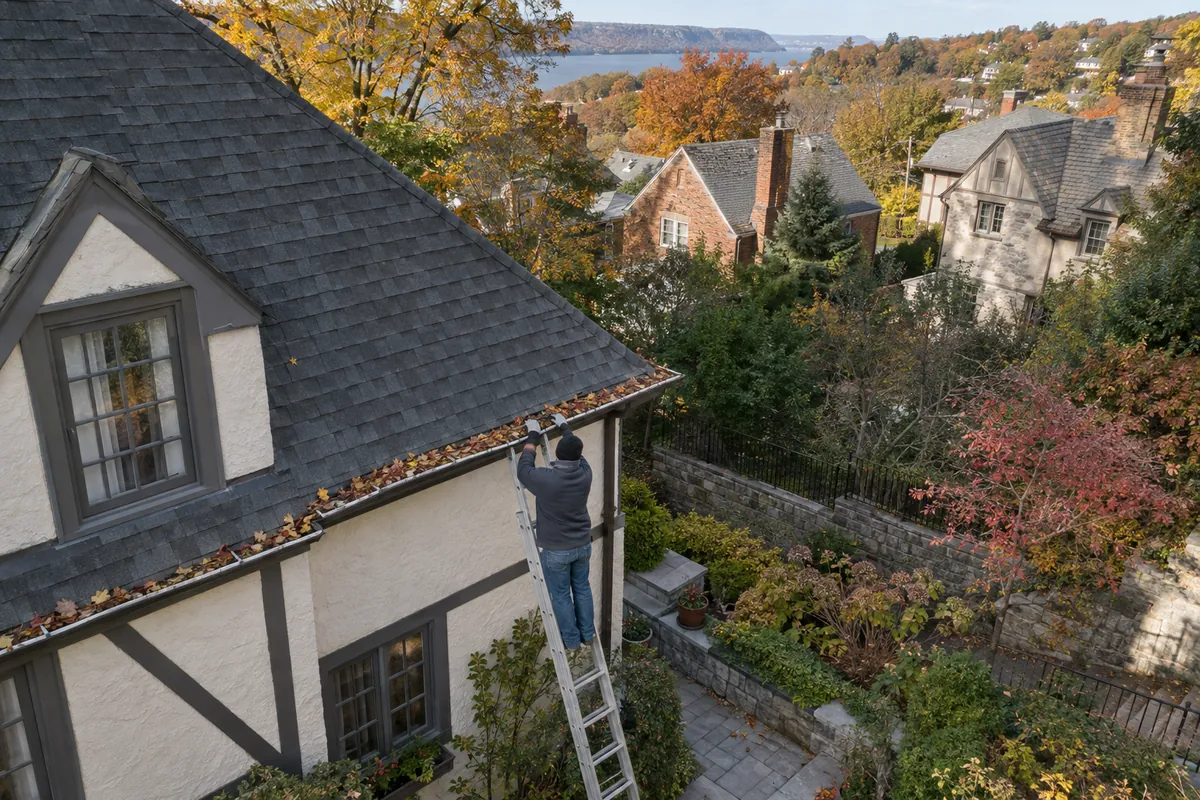
Fall delivers the heaviest debris load. Yonkers' signature oaks drop leaves well into December — weeks after maples and sweetgum have finished. Elm trees contribute their share through mid-November, while sweetgum's spiky seed balls create unique blockage problems at downspout openings. This staggered leaf drop means a single October cleaning rarely captures the full seasonal load.
Winter compounds existing problems. Water trapped in clogged gutters freezes, expands, and separates seams. Ice dams form along the roofline when backed-up meltwater refreezes at the eaves, forcing moisture under shingles and into attic spaces. The freeze-thaw cycles common from November through March in Westchester County can turn a minor clog into a structural repair within a single season.
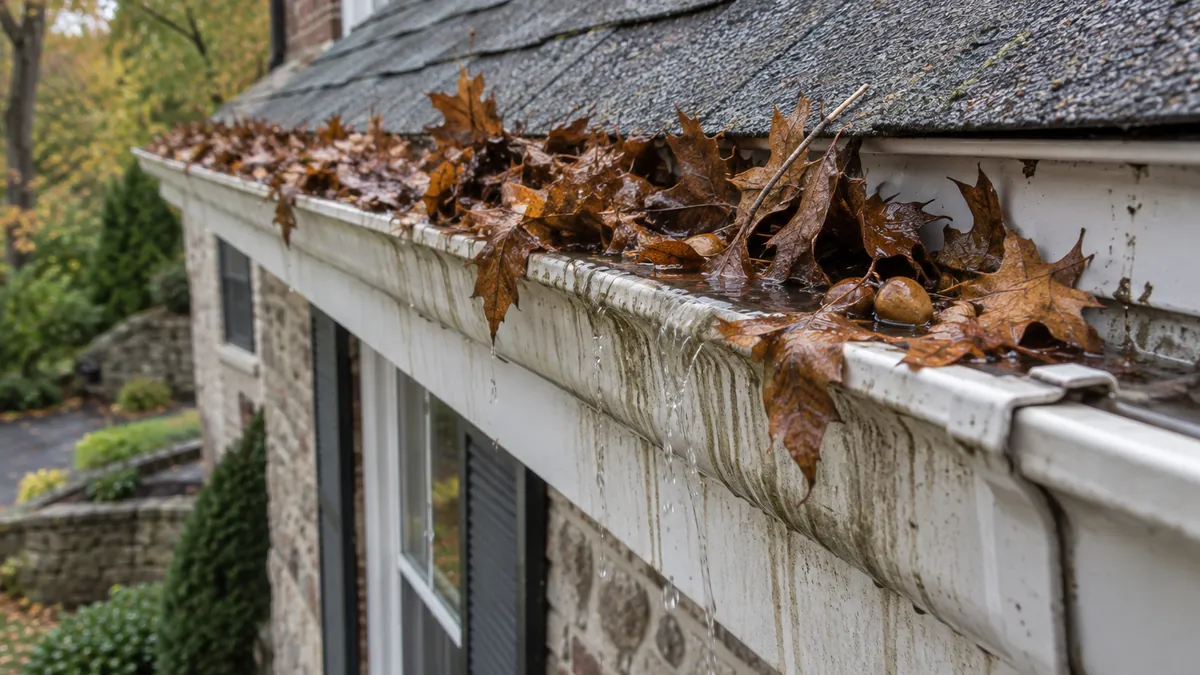
Certain Yonkers neighborhoods face elevated gutter maintenance demands due to their mature tree canopy. Crestwood and Park Hill feature towering oaks and maples planted decades ago, creating heavy canopy that drops enormous volumes of leaves directly onto rooflines. Bryn Mawr Park and Greystone share similar conditions, with large lots and established landscaping that generates year-round debris. Properties in these areas typically require three to four cleanings annually rather than the standard two.
Multi-story challenges add complexity throughout Yonkers. The city's substantial inventory of pre-war housing — including two-and-a-half and three-story colonials, Tudors, and row houses — requires specialized access equipment for safe gutter service. Second and third-story gutters accumulate debris at the same rate as ground-level systems but go uninspected far longer, often developing compacted blockages that standard cleaning cannot address without professional-grade tools.
Typical pricing ranges for residential gutter cleaning in the Yonkers area. Actual costs vary based on home size, roof pitch, accessibility, and gutter condition.
| Service | Price Range | Notes |
|---|---|---|
| Single-Story Home | $85 – $150 | Up to ~150 linear feet of gutter |
| Two-Story Home | $150 – $275 | Standard colonial, Tudor, or split-level |
| Three-Story / Complex | $250 – $400 | Multi-level rooflines, steep pitch, limited access |
| Heavily Clogged / Neglected | $200 – $450 | Compacted debris, plant growth, structural buildup |
| Downspout Flush | Included or $25 – $50 | Add-on if deep blockage requires hydro clearing |
| Gutter Inspection | Often Included | Visual check of seams, pitch, and fasteners |
| Seasonal Maintenance Plan | 10 – 15% Discount | Pre-scheduled multi-visit annual agreement |
Prices reflect typical Yonkers-area market rates and are provided for general reference only. Final pricing depends on property-specific factors including roof height, total linear footage, gutter condition, and accessibility. Request a free estimate for accurate project pricing.
No obligation — free estimates available Monday through Saturday.
Each season presents distinct gutter challenges across Yonkers and Westchester County. Understanding the debris cycle helps homeowners time their maintenance for maximum protection.
Spring transforms Yonkers gutters into pollen traps. Oak and maple trees release massive quantities of catkins and seeds that combine with residual winter grit to form a dense, paste-like sludge. This sticky layer coats gutter interiors and clings to downspout walls, reducing flow capacity before the first heavy spring rains arrive. A thorough spring cleaning removes this biological buildup and reveals any winter damage that needs repair before the wet season.
Westchester's summer thunderstorms deliver intense, short-duration rainfall that overwhelms partially clogged gutters within minutes. Wind-driven debris from storms — broken twigs, stripped leaves, and shingle granules loosened by UV exposure — accumulates rapidly. Summer heat also accelerates decomposition of any organic matter remaining from spring, creating odor issues and breeding habitat for mosquitoes in standing water. A mid-summer check prevents these compounding problems.
Fall is the critical cleaning season for every Yonkers property. The city's mixed hardwood canopy — sweetgum, maple, oak, and elm — drops leaves on staggered schedules from late September through mid-December. Sweetgum's distinctive seed balls create particular problems at downspout openings. The ideal timing targets late November after the majority of leaf fall, capturing maximum debris before winter freezing locks organic matter in place and creates conditions for ice dams.
Yonkers averages 25 inches of snowfall annually, and freeze-thaw cycles are relentless between December and March. Any debris remaining from fall traps meltwater, which refreezes into ice blockages that expand gutter seams and pull hangers from fascia boards. Ice dams form when backed-up water refreezes at the roof edge, forcing moisture under shingles. Winter spot-checks on problem areas can prevent small issues from escalating into costly spring repair projects.
Professional gutter cleaning follows a systematic approach that addresses every component of the drainage system — from initial safety assessment through final documentation.
Every appointment begins with a property assessment to determine the safest access approach. Ladder placement, roof pitch, ground conditions, and power line proximity are evaluated before any work starts. Multi-story Yonkers homes and properties with steep-pitch rooflines may require stabilizer bars or specialty equipment for safe, stable access.
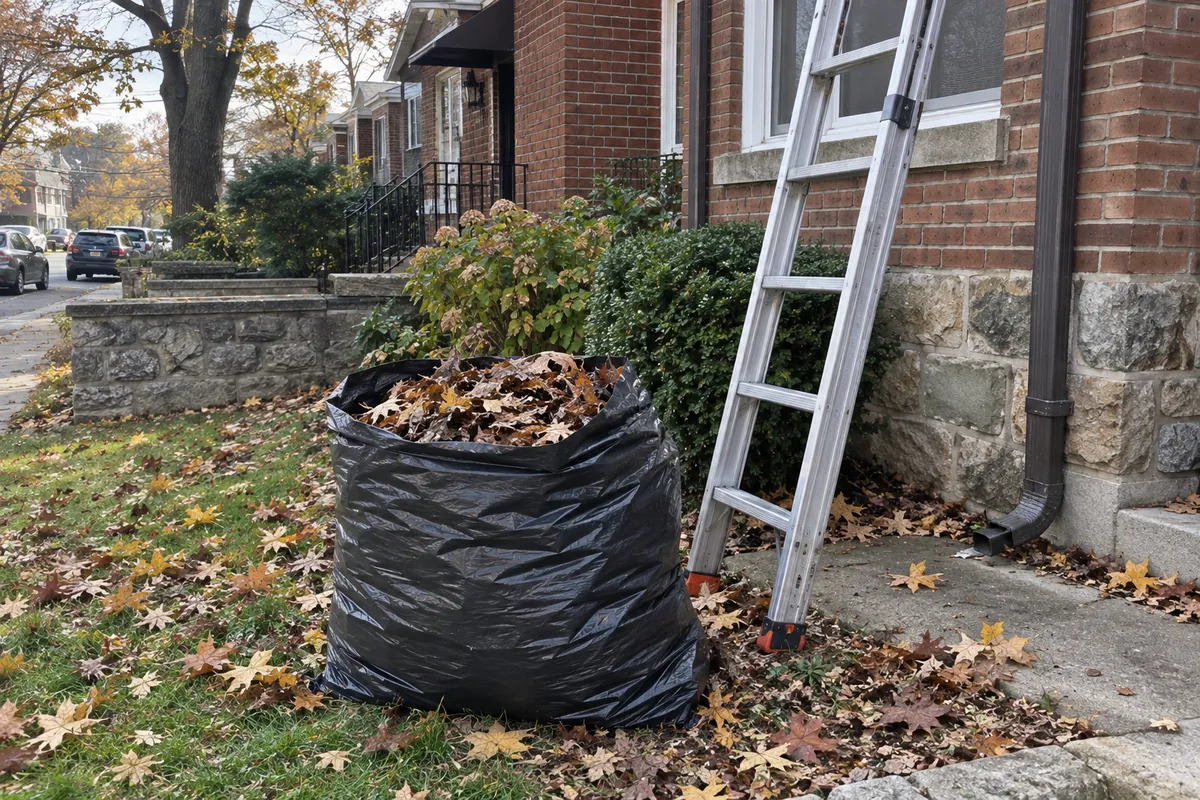
All loose and compacted debris is removed from gutter channels by hand and with professional scooping tools. Leaves, twigs, shingle granules, seed pods, and decomposed organic matter are cleared from every linear foot of gutter. Material is collected rather than scattered, keeping landscaping and walkways clean throughout the process.
Each downspout is checked for blockages by running water through from the top. Clogs — commonly caused by sweetgum seed balls, compacted leaf matter, or accumulated sediment — are cleared using pressure flushing or specialized auger tools. Downspout elbows and underground extensions receive particular attention since they trap debris at every bend.
After debris removal, the entire gutter system is flushed with water to verify unobstructed flow from each section to its corresponding downspout. Flushing also reveals slow drainage areas that indicate pitch problems, standing water zones, or partial blockages that hand-clearing may have missed. Proper flow is confirmed at every outlet.
With gutters cleared, a thorough visual inspection checks for loose or missing hangers, open seams, corrosion spots, fascia board damage, and proper pitch alignment. End caps, miters, and splash guards are examined. Any issues discovered are documented and communicated, allowing homeowners to address problems before they worsen.
All removed debris is collected and disposed of — nothing is left on the roof, in landscaping beds, or on walkways. The homeowner receives a summary of work performed, the current condition of the gutter system, and any recommended repairs or follow-up maintenance. Photos of notable findings are provided when applicable.
Deferred gutter maintenance compounds quickly. What begins as a minor leaf accumulation can escalate into foundation damage, structural rot, and expensive interior repairs within a single season.
Overflowing gutters dump concentrated water directly against the foundation perimeter. Over time, this saturates surrounding soil and creates hydrostatic pressure against basement walls. In Yonkers, where clay-heavy soils retain moisture, the erosion can undermine footings and crack foundation walls — repairs that routinely exceed $5,000 to $15,000.
Standing water in clogged gutters wicks into the fascia board behind the gutter channel. Wood fascia — standard on most Yonkers pre-war homes — absorbs this moisture and begins to rot from the inside out. Damage often goes unnoticed until the gutter system begins pulling away from the roofline or dark staining appears beneath the eaves.
A single downspout handles drainage for 400 to 600 square feet of roof surface. When that downspout is blocked, every inch of rainfall sends dozens of gallons cascading over the gutter edge and pooling at the foundation. For Yonkers homes receiving 50 inches of annual rain, even partial blockages translate to hundreds of gallons of misdirected water each storm.
Clogged gutters trap water that freezes during Yonkers' November-through-March cold cycles. This ice expands inside the gutter channel, separating seams and bending hangers. Worse, backed-up ice creates ridge dams along the roof edge that force snowmelt under shingles, causing leaks into attic spaces, ceilings, and wall cavities — damage that may not become visible until spring.
Decomposing leaves and standing water in neglected gutters create ideal nesting and breeding habitat. Mosquitoes lay eggs in stagnant water pools. Birds, squirrels, and wasps build nests in compacted debris. Carpenter ants follow moisture trails from wet gutter debris into fascia and soffit wood, potentially establishing satellite colonies inside the structure.
Gutter overflow concentrates water flow into narrow bands directly below the roofline rather than distributing it through the downspout and drainage system. This focused stream erodes mulch beds, exposes plant roots, carves channels in lawn areas, and splashes soil against siding and foundation walls. Established landscaping near Yonkers homes can suffer significant damage from a single season of overflow.
No obligation — free estimates available Monday through Saturday.
Most Yonkers homes benefit from gutter cleaning two to four times per year. Properties surrounded by mature oaks, maples, sweetgum, and elm trees — common throughout Crestwood, Park Hill, and Bryn Mawr Park — typically need quarterly service. At minimum, schedule a thorough cleaning in late fall after peak leaf drop and again in early spring before the heavy rain season begins.
Gutter cleaning costs in Yonkers typically range from $85 to $150 for single-story homes, $150 to $275 for two-story homes, and $250 to $400 for three-story or complex rooflines. Heavily clogged or neglected systems may run $200 to $450. Downspout flushing is often included, and seasonal maintenance plans offer 10 to 15 percent savings.
Late fall — typically mid-November through early December — is the most important cleaning window for Yonkers homes. This timing captures the bulk of leaf drop from oaks, maples, and sweetgum trees before winter freezes arrive. A secondary spring cleaning in March or April clears accumulated winter debris, pine needles, and pollen buildup before the heavy rainfall season.
Yes. When gutters overflow, water pools around the foundation and saturates the surrounding soil. This creates hydrostatic pressure against basement walls, forcing water through cracks, mortar joints, and the floor-wall seam. In Yonkers, where annual rainfall exceeds 50 inches, a single clogged downspout can dump hundreds of gallons directly against the foundation during a heavy storm.
Most residential gutter cleaning appointments in Yonkers take between one and two hours. Single-story ranch homes with straightforward rooflines may be completed in under an hour, while larger two-story colonials or multi-level homes with complex roof angles typically require closer to two hours. Severely neglected systems with compacted debris or plant growth may take longer.
No. Gutter guards significantly reduce cleaning frequency — typically by 80 to 90 percent — but they do not eliminate maintenance entirely. Fine debris like pine needles, shingle granules, and pollen can still accumulate on top of or beneath guard systems. An annual inspection and light cleaning remains recommended even with high-quality micro-mesh guards installed.
Five visible indicators signal that gutters need attention: water overflowing during rain, visible plant growth or debris protruding from the gutter channel, sagging or pulling away from the fascia board, staining or mildew streaks on exterior walls below the gutter line, and standing water or erosion channels forming near the foundation. Any of these warrants prompt professional inspection.
Clear gutters protect foundations, prevent ice dams, and keep basements dry. Call for a free estimate on professional gutter cleaning anywhere in Yonkers and Westchester County.
Call For Free Estimate