Micro-mesh protection systems that reduce cleaning frequency by up to 90 percent.
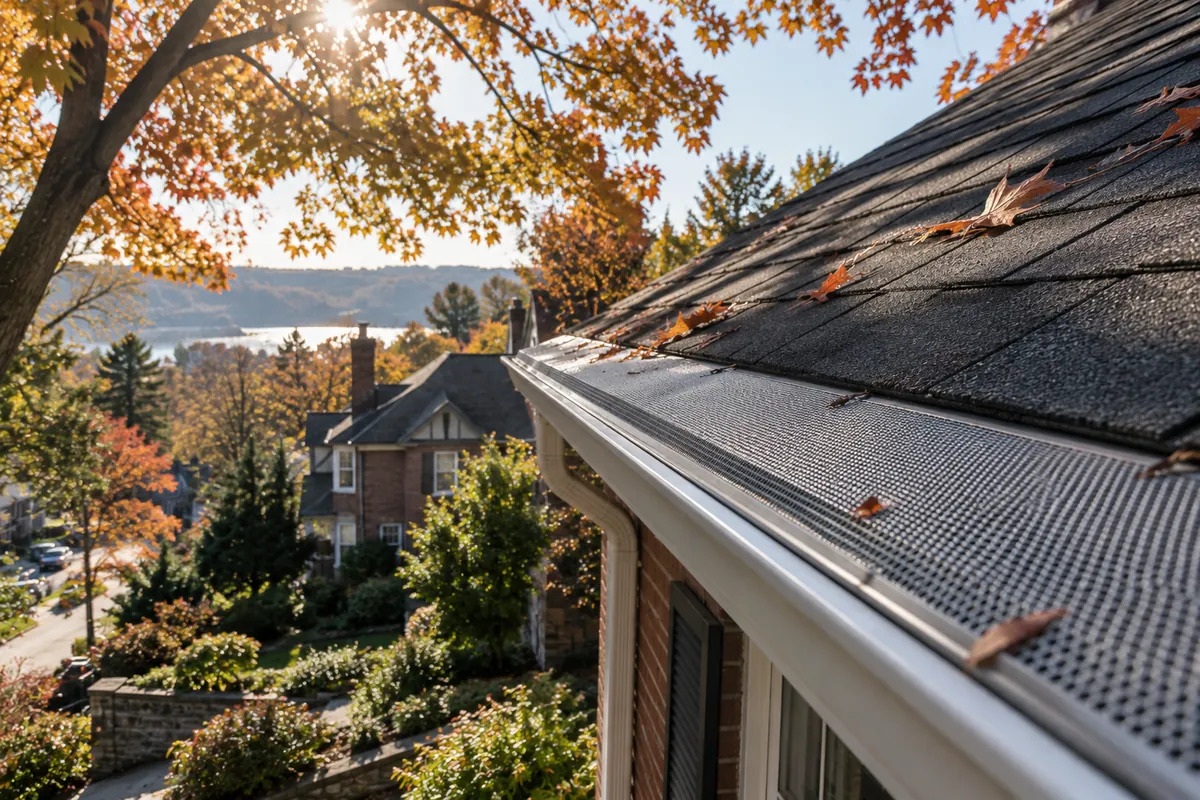
Yonkers properties face a debris challenge that most suburban communities simply do not encounter at the same scale. The city's mature deciduous canopy — part of Westchester County's extensive urban tree network, dominated by red oaks, sugar maples, and sweetgum trees — drops an enormous volume of leaves each fall. But autumn is only part of the problem. Spring brings helicopter seeds and pollen clusters, summer produces cottonwood fluff and insect nests, and winter delivers pine needles and ice-damaged twigs. Without a physical barrier over the gutter channel, this debris accumulates rapidly and creates blockages that lead to water overflow, fascia rot, and foundation erosion.
Gutter guards work by covering the open top of the gutter trough with a barrier that allows rainwater to pass through while deflecting solid debris. The specific mechanism varies by guard type: mesh systems use fine screening to filter out particles, reverse-curve designs rely on surface tension to guide water into the channel while debris falls off the edge, and foam or brush inserts sit inside the gutter to block large debris from settling.
Three factors make gutter guards especially valuable across Yonkers. First, the area receives approximately 50 inches of rainfall annually, well above the national average. That volume of water demands clear, unobstructed gutters to manage roof runoff effectively. Second, Westchester County accumulates around 25 inches of snowfall each winter, and the freeze-thaw cycle from November through March can turn minor gutter blockages into ice dams that damage roofing materials and interior walls. Third, much of the city's housing stock dates to the pre-war and mid-century eras, meaning aging gutter systems are already more vulnerable to the stress of debris accumulation.
Certain neighborhoods experience higher debris loads than others. Crestwood, with its established residential lots and towering red oaks, generates some of the heaviest leaf fall in the city. Park Hill and Bryn Mawr Park feature mature maples and elms that drop dense canopy material from September through November. Greystone, bordering the Hudson River, contends with both deciduous debris and the moisture-driven algae growth that accelerates gutter deterioration when channels stay clogged.
The financial case for gutter guards rests on three pillars: reduced cleaning costs, prevented water damage, and extended gutter lifespan. Professional gutter cleaning in Westchester County typically runs $150 to $350 per visit, and most Yonkers homes need at least two cleanings per year. Properties under heavy canopy may require quarterly service. Over a decade, that cleaning expense alone can reach $3,000 to $14,000. Quality gutter guards reduce cleaning frequency by 80 to 90 percent, collapsing that recurring cost to an occasional inspection.
The prevented-damage calculation is even more compelling. A single water intrusion event caused by overflowing gutters can produce $5,000 to $15,000 in foundation, siding, or interior damage — a risk underscored by Westchester County's flood mitigation planning, which identifies multiple flood-prone watersheds across the region. Guards eliminate the primary cause of those overflows.
Most Yonkers homeowners recoup the full cost of a professional gutter guard installation within 5 to 8 years through reduced cleaning expenses and prevented water damage. Properties with heavy tree canopy coverage often reach payback even faster.
Yonkers has a homeownership rate of approximately 46.2 percent, meaning a significant portion of the housing stock consists of multi-family rentals, condominiums, and mixed-use buildings. These multi-story structures present unique gutter maintenance challenges: cleaning requires longer ladders, scaffolding, or lift equipment, increasing both cost and safety risk. Gutter guards are particularly cost-effective on multi-family properties where the per-unit cleaning expense is high and the consequences of deferred maintenance, including tenant complaints and code violations, compound quickly.
Not all gutter guards perform equally. The right choice depends on the specific debris types surrounding the property, roof pitch, rainfall intensity, and budget. Here is how the five main guard categories compare for Yonkers conditions.
| Guard Type | Price per LF | Lifespan | Best For | Yonkers Rating |
|---|---|---|---|---|
| Micro-Mesh | $12 - $20 | 15 - 25 years | All debris types | Excellent |
| Screen Guards | $4 - $8 | 10 - 15 years | Large leaves | Good |
| Reverse Curve | $8 - $15 | 15 - 20 years | Low-debris areas | Fair |
| Foam Inserts | $2 - $5 | 3 - 5 years | Budget / temporary | Poor |
| Brush Guards | $3 - $6 | 5 - 8 years | Large leaves only | Fair |
Prices reflect Westchester County averages including professional installation. Material-only costs are lower for DIY approaches, though professional fitting is recommended for warranty coverage and optimal performance.
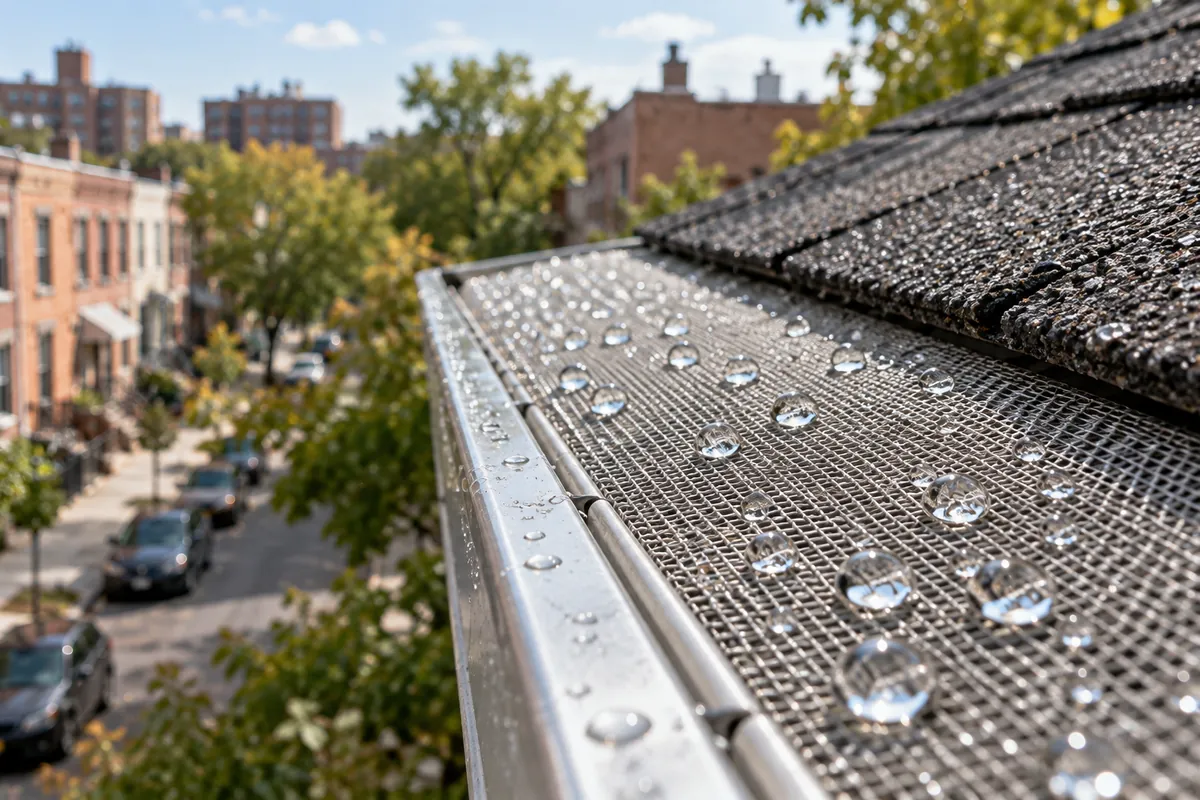
Micro-mesh guards use surgical-grade stainless steel screening over an aluminum frame to block even the finest debris particles. Pine needles, maple seeds, shingle grit, and pollen are all filtered out while water flows through unimpeded. These systems handle Yonkers' heaviest rainfall without sheeting or overflow, and the stainless steel mesh resists corrosion from the region's freeze-thaw cycling. The higher upfront cost is offset by a 15- to 25-year lifespan and near-zero maintenance requirements.
Aluminum or plastic screen guards snap onto the gutter lip and provide a basic barrier against large debris. They handle broad maple and oak leaves effectively but struggle with pine needles, small seeds, and pollen, which can slip through the wider mesh openings. For Yonkers properties without significant coniferous trees nearby, screens offer a reasonable mid-range option. Expect 10 to 15 years of service before replacement is needed.
Reverse curve systems use a solid cover with a curved lip that guides water into a narrow slot via surface tension. Leaves and large debris slide off the curved surface. The limitation is heavy rain: when rainfall exceeds 2 to 3 inches per hour, as it can during Yonkers nor'easters, water can sheet over the curve and miss the gutter entirely. These systems also tend to collect small debris at the slot opening, requiring periodic brushing.
Foam inserts sit inside the gutter channel and allow water to filter through the porous material while blocking debris on the surface. However, foam degrades under UV exposure within 3 to 5 years, and organic material can take root inside the foam itself, leading to plant growth within the gutter. The porous structure also traps fine debris internally, reducing water flow over time.
Not recommended for Yonkers conditionsBrush-style guards consist of cylindrical bristle inserts that sit in the gutter channel. Large leaves rest on top of the bristles while water flows through. The problem is that smaller debris, including pine needles, seeds, and shingle grit, becomes trapped between the bristles and is difficult to remove without pulling the entire insert out for cleaning. For properties under heavy pine or mixed-canopy coverage, brush guards may require more maintenance than they prevent.
For the mix of deciduous and coniferous debris that characterizes most Yonkers neighborhoods, micro-mesh gutter guards deliver the strongest overall performance. The combination of fine filtration, high water throughput, corrosion resistance, and multi-decade lifespan makes micro-mesh the clear top choice for Westchester County properties. Homeowners on tighter budgets with primarily large-leaf debris may find screen guards to be a reasonable alternative.
No obligation — free estimates available Monday through Saturday.
Professional gutter guard installation follows a five-step process that ensures proper fit, optimal drainage, and long-term performance. Most residential projects are completed in a single visit.
A thorough inspection of the existing gutter system checks for structural integrity, proper slope, secure fascia attachment, and any damage that needs repair before guards are installed. Sagging sections, loose hangers, and corroded joints are identified and documented.
Based on the property's tree coverage, roof pitch, gutter profile, and budget, the appropriate guard type and material are recommended. Measurements are taken for each gutter run to ensure precise fitting with minimal gaps at seams and corners.
Every gutter channel is completely cleaned of all existing debris, including packed leaves, silt, shingle grit, and organic buildup. Downspouts are flushed to confirm unobstructed drainage. Installing guards over dirty gutters defeats the purpose of the investment.
Guards are secured to the front lip of the gutter using clips, screws, or tension-fit mechanisms depending on the product. Proper installation avoids any contact with roofing shingles, preserving the roof warranty. Miters are cut for inside and outside corners, and end caps are sealed.
Water is run through each gutter section to verify proper flow rate, confirm that water enters the channel without sheeting or dripping behind the guard, and check that downspouts handle the volume without backing up. Any adjustments to guard positioning or gutter slope are made on the spot.
The short answer is no. Gutter guards reduce cleaning frequency by 80 to 90 percent, which is a transformative improvement for most homeowners, but they do not make gutters entirely maintenance-free. Any company claiming that guards eliminate cleaning altogether is overstating the product's capabilities, and that overpromise is one of the most common complaints in the gutter protection industry.
Even with the finest micro-mesh installed, certain materials can still accumulate. Shingle grit, fine pollen dust, and airborne silt gradually build up inside the gutter channel over years. On top of the guards, pine needles and small seeds can occasionally bridge the mesh surface and need to be brushed away. In heavily wooded areas, organic material on the guard surface may develop a thin film of moss or algae if left unchecked for extended periods.
The practical recommendation is an annual inspection, ideally in late fall after the major leaf drop. This inspection is far less involved than a full gutter cleaning: a quick visual check from a ladder, a rinse of the guard surface with a garden hose, and a look inside the downspout openings to confirm clear flow. Compared to the twice-yearly or quarterly hands-on cleaning that unprotected gutters demand, the maintenance reduction is substantial.
This honest perspective is a differentiator worth noting. Homeowners who understand what guards actually deliver, and what they do not, make better purchasing decisions and report higher satisfaction with the end result. Realistic expectations set the foundation for a positive long-term experience with any guard system.
No obligation — free estimates available Monday through Saturday.
Answers to the most frequently asked questions about gutter guard installation, performance, and value for Yonkers homeowners.
Gutter guards deliver strong long-term value for most Yonkers properties, particularly those surrounded by mature oaks, maples, and sweetgum trees. The typical payback period falls between 5 and 8 years when factoring in reduced cleaning costs, prevented water damage, and extended gutter lifespan. Neighborhoods with dense canopy coverage like Crestwood, Park Hill, and Bryn Mawr Park see the fastest return on investment.
Micro-mesh gutter guards are the top recommendation for Westchester County homes. The region's mix of deciduous and coniferous trees produces everything from large maple leaves to fine pine needles, pollen, and helicopter seeds. Micro-mesh systems with surgical-grade stainless steel screening block all of these debris types while maintaining strong water flow during the area's heaviest rainstorms.
Most quality gutter guard systems handle heavy rainfall effectively. Micro-mesh and screen guards maintain water intake during storms producing 1 to 2 inches per hour. Reverse-curve guards can experience water sheeting during extreme downpours exceeding 2 to 3 inches per hour, where surface tension fails and water overshoots the gutter entirely. For Yonkers properties that experience intense nor'easter rainfall, micro-mesh provides the most reliable heavy-rain performance.
Gutter guard lifespan varies significantly by material and construction. Quality micro-mesh guards with aluminum frames and stainless steel screening last 15 to 25 years. Aluminum screen guards typically deliver 10 to 15 years of service. Reverse-curve systems last 15 to 20 years. Foam inserts have the shortest lifespan at 3 to 5 years due to UV degradation and organic material accumulation within the foam structure.
Properly installed gutter guards do not void roof warranties. Guards that attach to the gutter lip rather than sliding under roofing shingles preserve the roof manufacturer's warranty terms. Any system that requires lifting, bending, or penetrating roof shingles for installation could potentially void coverage. Homeowners should confirm the installation method before any guard work begins.
Gutter guards reduce cleaning frequency by 80 to 90 percent but do not eliminate the need entirely. Fine debris like pollen, shingle grit, and small seed particles can gradually accumulate inside the gutter channel. An annual inspection and light cleaning ensures optimal performance. Properties under heavy pine or oak canopy may benefit from a twice-yearly check, though this is far less involved than cleaning unprotected gutters.
Gutter guard installation costs in Yonkers range from $2 to $20 per linear foot depending on the guard type. Foam inserts run $2 to $5 per linear foot, brush guards $3 to $6, screen guards $4 to $8, reverse-curve systems $8 to $15, and micro-mesh guards $12 to $20. A typical Yonkers home with 150 to 200 linear feet of guttering can expect to pay between $1,800 and $4,000 for a professional micro-mesh installation.
Free on-site estimates, expert guard selection guidance, and professional installation across Yonkers and Westchester County. Call today to protect every gutter on the property.
Call For Free Estimate